Pages

Showing posts with label Autism. Show all posts

Sunday, October 7, 2012

I bambini con autismo tendono ad allontanarsi (rtw)

http://www.nytimes.com/2012/10/08/science/study-shows-autistic-children-are-likely-to-wander.html?partner=rss&emc=rss&smid=tw-nytimes&_r=0

Study Shows Children With Autism Tend to Stray

Brendan Bannon for The New York Times
Patrick Murphy, 14, will sometimes sneak out of the house to pursue his latest interest.
When Patrick Murphy was 6, he became obsessed with vacuum cleaners. The boy, who has autism, used to slip out of his house near Buffalo without telling his parents, running to a nearby appliance store or into strangers’ homes to marvel at vacuum cleaners.
Patrick is now 14, and his parents have double bolts on the doors in their home and brackets on their windows. Still, Patrick — who is now focused on dogs — manages to sneak out. Two weeks ago, he crept from the house after his mother went to bed. When his father came home, he alerted the police. They found Patrick running barefoot in his pajamas at 2 a.m., three miles from his home.
“That was very scary,” said Patrick’s father, Brian Murphy, who has now added an alarm system to the house to keep his son safe. “He has broken through brackets, windows, picked locks, you name it. It’s absolutely the most stressful part of parenting a child with autism.”
The behavior, called wandering or elopement, has led to numerous deaths in autistic children by drowning and in traffic accidents. Now a new study of more than 1,200 families with autistic children suggests wandering is alarmingly common. Nearly half of parents with an autistic child age 4 or older said their children had tried to leave a safe place at least once, the study reported. One in four said their children had disappeared long enough to cause concern. Many parents said their wandering children had narrowly escaped traffic accidents or had been in danger of drowning.
Those at greatest risk of wandering off were autistic children with severe intellectual deficits and those who do not respond to their names. The research was published on Monday in the journal Pediatrics.
“I knew this was a problem, but I didn’t know just how significant a problem it was until I really began to look into it,” said Dr. Paul A. Law, senior author of the study and director of the Interactive Autism Network, a registry that is a project of the Kennedy Krieger Institute in Baltimore. “This is probably one of the leading causes of death and morbidity for kids with autism.”
Advocates for families affected by autism say the findings underscore the need to raise public awareness and alter policy. While Amber alerts are used to mobilize the public when a child is believed to have been abducted, for instance, generally they are not used when a disabled child goes missing, said Alison Singer, president and a founder of the Autism Science Foundation, one of the organizations that supported the study.
Emergency responders should receive special training on how to search for autistic children who are nonverbal and often scared by lights and sirens, she said. Emergency personnel also need to know to check streams or ponds, since many children with autism are drawn to bodies of water, as well as highways.
One in 88 children in the United States received a diagnosis of autism, Asperger syndrome or a related disorder in 2008, according to the Centers for Disease Control and Prevention. While some of these children are socially awkward but high functioning, others have limited intellectual and cognitive abilities.
“For children who are prone to wander, this is a pervasive problem that affects all aspects of families’ lives,” Dr. Law said. “Many parents just don’t go out in public with their child because they don’t feel safe with them, or they don’t get any sleep at night because the child once escaped through the upstairs window.”
The idea for the new study came from a family coping with autism, and it was financed by several advocacy organizations. Researchers surveyed families who had a child with autism or a related disorder between the ages of 4 and 17.
Most of the respondents came from 1,098 of Interactive Autism Network’s most active participants, 60 percent of whom completed the survey. Families who chose to participate knew the survey was about wandering, and those coping with wandering children may have been more likely to respond, skewing the results, Dr. Law acknowledged.
Over all, 49 percent of families who participated said a child with autism had tried to wander from home, school or another safe place at least once after age 4; the peak age for wandering was 5. Some parents said their child wandered off several times a week or even several times a day.
“This is the first study to quantify the scope of the problem, and it was much larger than we thought,” Ms. Singer said.

Tuesday, August 7, 2012

Dalla Spagna e-Mintza - nuovo SW che aiuta i bambini autistici

New computer software helps autistic communicate

http://www.euronews.com/2012/08/02/new-computer-software-helps-autistic-communicate/

 A special computer programme called “e-mintza” – Basque for “electronic language” – has been developed to help autistic A special computer programme called ‘e-Mintza’ – Basque for “electronic language“ - has been developed to help autistic people overcome communication barriers.

The application uses pictograms to create games using images and sounds.

It is the brainchild of Doctor Joaquin Fuentes, who heads up the child and teenage psychiatric department in San Sebastian’s largest medical centre.

02/08 15:58 CET

Thursday, April 26, 2012

Third international conference on Autism, next October in Riva del Garda, Italy

http://www.convegni.erickson.it/autismi/

Autismi (Riva del Garda, Trento, 15 - 16 ottobre 2012 )

Le novità su diagnosi, intervento e qualità di vita.


Il Convegno è strutturato in 2 sessioni plenarie e in 21 workshop di approfondimento per un totale di 15 ore di formazione (7 ore di sessioni plenarie e 8 ore di workshop di approfondimento).
Il Convegno verterà su:
• Le nuove linee guida nazionali per il trattamento dei disturbi dello spettro autistico
• Epidemiologia dell’autismo
• Genetica e autismo
• Comorbilità psichiatriche e terapie farmacologiche
• Basi neurali e neuroimaging
• Novità sugli strumenti per la diagnosi
• Indicatori per la diagnosi precoce
• Sindrome di Asperger e autismo ad alto funzionamento
• Autismo a scuola: adattamento delle attività didattiche
• Esiti dei trattamenti e degli interventi precoci
• Terapie intensive per l’autismo
• Autismo e qualità di vita
• La ricerca scientifica nell’autismo
• Autismo: strategie operative per la vita di tutti i giorni
• Diritti e tutele nel campo dell’autismo
• Servizi territoriali e politiche regionali a favore dell’autismo
• Integrazione sociale: interventi mirati alle abilità sociali e interpersonali
• Alunni con disturbi generalizzati dello sviluppo
  e qualità inclusiva della scuola
• Progetto e qualità di vita nelle famiglie con un figlio autistico
• L’uso di libri e storie con la CAA
• Interventi e strategie psicoeducative: ABA e TEACCH
• Il lavoro con i genitori: proposte di parent training
• Autismo e nuove tecnologie
• Psicomotricità e autismo
• Autismo e acquaticità
• Facilitare la comunicazione attraverso la musica
• Buone prassi

Friday, April 20, 2012

Ognuno il suo tempo (GIANCARLO Leopardi) - Sant'Egidio - Area di Servizio


Ognuno il suo tempo
(GIANCARLO Leopardi)
Ognuno ha il suo tempo per imparare,
io per esempio imparo piano piano, ma imparo, io capisco, ma subito non so dire, rispondere.
Piano piano sono arrivato alle superiori,
ci vuole pazienza e la scuola deve avere pazienza.
Prima non ce l’aveva,
chi aveva delle difficoltà stava da un’altra parte,
non c’era pazienza di aspettare e non si imparava.
Meno male che  non è più così, se no come facevo io a studiare.

Testo registrato al laboratorio durante un incontro sul tema della scuola

http://www.santegidio.org/index.php?idLng=1062&pageID=3091

°§°§°§°  
AREA DI SERVIZIO Puntata del 21 aprile 2012
DIRITTI E DISABILITA'

Le notizie della settimana
.
I vostri racconti.  Torniamo questa mattina a riproporvi due ultimi testi scritti dalle persone che frequentano i laboratori della comunità di Sant’Egidio  e che hanno fatto parte delle installazioni artistiche della mostra ospitata al Quirinale per i 150 anni dell’Unità d’Italia, e ancora il 21 e il 22 aprile è possibile visitare a Trento, nelle sale di Palazzo Calepini.  Ascolteremo il testo di Giancarlo Leopardi, una poesia sul tempo e la riflessione di Gabriele Tagliaferro sulle parole. A commentarle con noi, Vittorio Scelzo, responsabile per le attivitàdi Sant’Egidio che coinvolgono le persone disabili, e che ha seguito i lavori per la mostra

http://www.rai.it/dl/radio1/2010/programmi/Page-3ec299dc-a673-4cd3-88f3-e2af87cc2982.html

Friday, February 17, 2012

... autismo e dèmoni di Bijan Zarmandili ...

(il libro) I demoni del deserto

Bijan Zarmandili


collana: ebook / narrativa
978-88-7452-334-4 pagine: 268 14 prezzo: 16.00  ottobre 2011

I demoni del deserto  acquista il libro

È il 5 del 1383 secondo il calendario iraniano, il 26 novembre del 2006. Dal deserto che circonda la città di Bam si alza un Bad-e-margh, un vento di Morte, e in pochi secondi il terremoto annulla il paesaggio. Agha Soltani e sua nipote Hakimè sono gli unici a sopravvivere alla loro famiglia. Al tramonto, dopo la catastrofe, comincia il loro viaggio, a piedi, in direzione del Golfo e del mare, nel tentativo di ricostruire dalle macerie una nuova possibilità di vita. Agha Soltani è sempre stato un maestro, ma nulla capisce di Hakimè,
bambina silenziosa e ossessionata dal sangue, ( http://en.wikipedia.org/wiki/Autism )
che affascina chiunque la incontri con il suo incarnato scuro e il verde dei suoi occhi, a cui si offrono visioni di un mondo che non esiste. I loro passi saranno scanditi dalle risate dei jinn, i demoni del deserto che fanno sperdere le carovane e impazzire i fanciulli e forse anche Hakimè, ma che s’incarnano anche nei trafficanti di uomini, nei ladri di bambini e nella banda di Amir Khan che attenta all’esile unione che i due hanno costruito. Zarmandili descrive un’odissea contemporanea, un moderno racconto epico attraverso un mondo antico, in cui le leggende, le magie e le fascinazioni s’intrecciano alla cronaca dei nostri tempi di guerra.

per leggere le prime pagine del libro clicca qui

http://www.edizioninottetempo.it/catalogo/narrativa/i-demoni-del-deserto-2/


http://www.ilrecensore.com/wp2/2011/11/%E2%80%9Ci-demoni-del-deserto%E2%80%9D-intervista-a-bijan-zarmandili/

(l'autore) Bijan Zarmandili

Bijan Zarmandili (Teheran, 1941) dal 1960 vive a Roma, dove ha studiato architettura e scienze politiche. È stato per vent’anni fra i quadri dirigenti della sinistra iraniana in esilio e ha partecipato all’opposizione iraniana al passato regime dello scià. Ha cominciato l’attività giornalistica nel 1980, dopo la Rivoluzione islamica, ed è esperto di politica mediorientale per il gruppo Espresso-Repubblica. Ha pubblicato saggi sul mondo iranico e le biografie di Mohammad Mossadegh e dell’Ayatollah Khomeini (Cei 1974); Documenti di un dirottamento, sul caso dell’Achille Lauro (Eri 1988).
http://www.feltrinellieditore.it/SchedaAutore?id_autore=1000312

(la città) Bam (Iran)
http://it.wikipedia.org/wiki/Bam_%28Iran%29


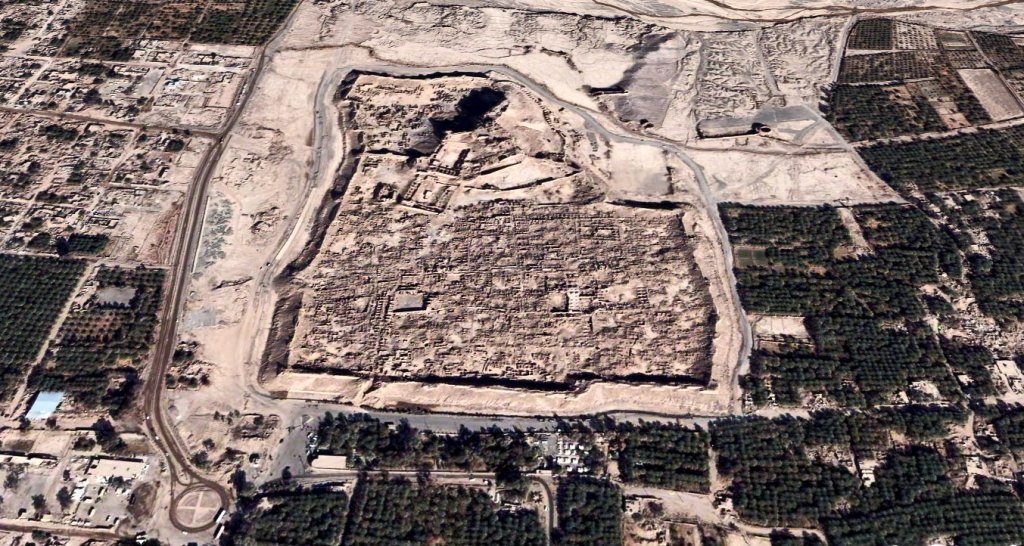
L'antica città-fortezza di Arg-é-Bam è stata distrutta nel 2003 da un forte terremoto. Era stata il set che rappresentava la Fortezza Bastiani nel film Il deserto dei Tartari tratto dal romanzo di Dino Buzzati. La vista da satellite è anteriore al terremoto. A Rayen invece c'è ancora una piccola cittadella-fortezza

http://www.inognidove.it/iran/travel/bam1.shtml

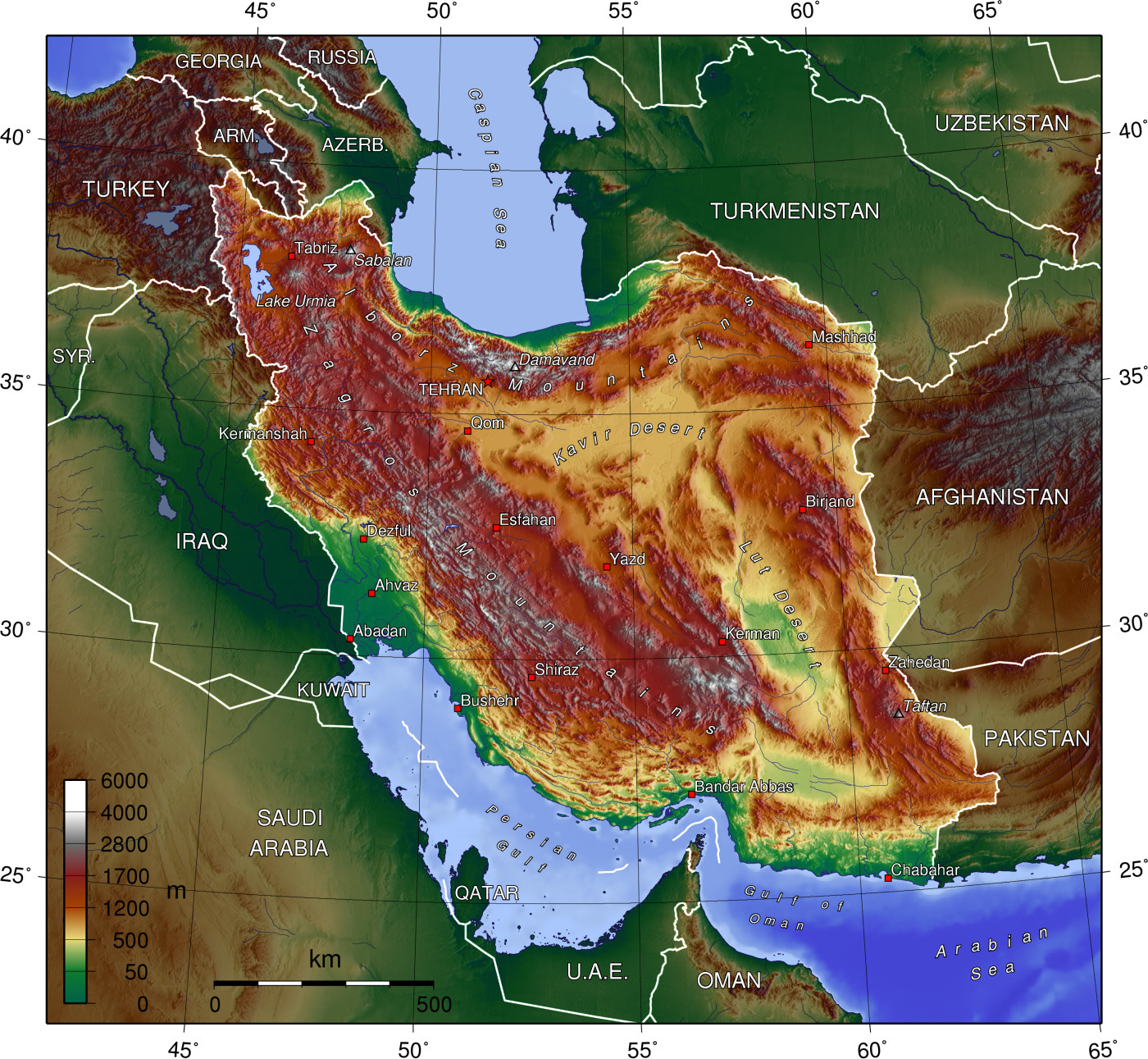
i Deserti

http://en.wikipedia.org/wiki/Dasht-e_Kavir
http://en.wikipedia.org/wiki/Dasht-e_Lut


Map of biotopes of Iran
  Forest steppe
  Forests and woodlands
  Semi-desert
  Desert lowlands
  Steppe
  Salted alluvial marshes
http://it.wikipedia.org/wiki/Iran
File:Iran topo en.jpg

i Terremoti

2006
http://earthquake.usgs.gov/earthquakes/eqinthenews/2006/uskyae/

2003

Exquisite-kfind.png Per approfondire, vedi la voce Terremoto di Bam.

Arg-e Bam prima del terremoto
Il 26 dicembre 2003, alle 5:26 locali (2:56 in Italia), la Cittadella di Bam - "la più grande struttura in mattoni al mondo" - e buona parte della città moderna vennero devastati da un terremoto. Lo United States Geological Survey ne stimò la magnitudo in 6,6.[3] La BBC disse che il "70% della città moderna di Bam" andò distrutta.[4] Si cominciò a parlare di circa 80 000 vittime, ed i media parlarono di 70 000 vite stroncate. In realtà il conto ufficiale delle vittime al 17 gennaio fu di 56 230, e future stime di Teheran dimezzarono il valore portandolo a 26 271. Altri 10 000 - 50 000 vennero dichiarati feriti, ma questa cifra è incerta; la cifra che si fa di solito è di 30 000, probabilmente perché è il numero riportato dalla Reuters. Secondo l'agenzia iraniana IRNA la vecchia cittadella venne "rasa al suolo".

(il poeta) Hafez  ... (la tradizione)


Hāfez. Dettaglio di un manoscritto
http://it.wikipedia.org/wiki/Hafez

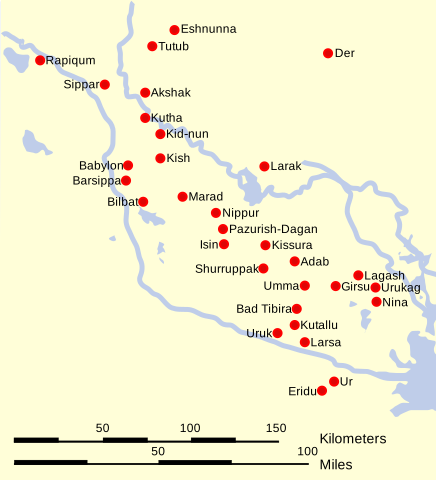
i Sumeri

http://en.wikipedia.org/wiki/Sumer


(il sociologo) Kian Tajbakhsh ... (la modernità)

Tajbakhsh was arrested at his home in Tehran on May 11, 2007,[3] as the fourth Iranian-American, after Ali Shakeri, Haleh Esfandiari and Nazi Azima, to be incarcerated, detained, or put under house arrest in 2007. He was held without charge in Evin Prison for more than four months.
According to the Free Kian website, Tajbakhsh was allowed to leave Evin Prison and be reunited with his wife in Tehran on September 19, 2007.[4]
Tajbakhsh was arrested again in Tehran on July 9, 2009.[5][6] He was among the thousands of people detained in the protests that followed the presidential election and he appeared at a mass trial in Tehran. Then he was charged with a number of offenses including espionage [7] Tajbaksh was one of many politicians, academics, journalists, and others arrested in the wake of the protests, and was one of the defendants in a widely condemned mass trial. The charges against him included his work for the OSI, which the Iranian government had approved earlier, and his subscribing to the Gulf/2000 mailing list run by Gary Sick[8] On October 20, 2009, he was sentenced to at least 12 years in prison on charges of espionage, "contacting foreign elements" and acting against national security.[8][9]

 http://en.wikipedia.org/wiki/Kian_Tajbakhsh

http://it.wikipedia.org/wiki/Modernit%C3%A0


Mia libreria

Followers

My site is worth